


What is the amount that will be available to children accepted into the program?
The amount depends on the child’s situation:
Private school students
State law sets the transfer amount at 85 percent of the statewide average of state and local funding per student in Texas public schools. The Texas Education Agency (TEA) will determine the exact amount for the first year of the program in January 2026, but it is estimated at approximately $10,800 per child if the student attends an approved private school.
Students with disabilities who have an individualized education plan (IEP) on file with their school district may receive more, up to $30,000 per year.
This TEFA Disability Certification Form is to be completed by a licensed professional for a child to have priority for a TEFA award (but not increased funding). Here are instructions to fill out this form. If you have any questions that are not answered in these documents, please contact businessoffice@lccs.org.
Families who are applying for a TEFA, and have a student who has an active IEP from a public school district (from Texas) will need their UID number for their application. Here is the weblink to look up your child’s UID.
Will every child who applies be approved?
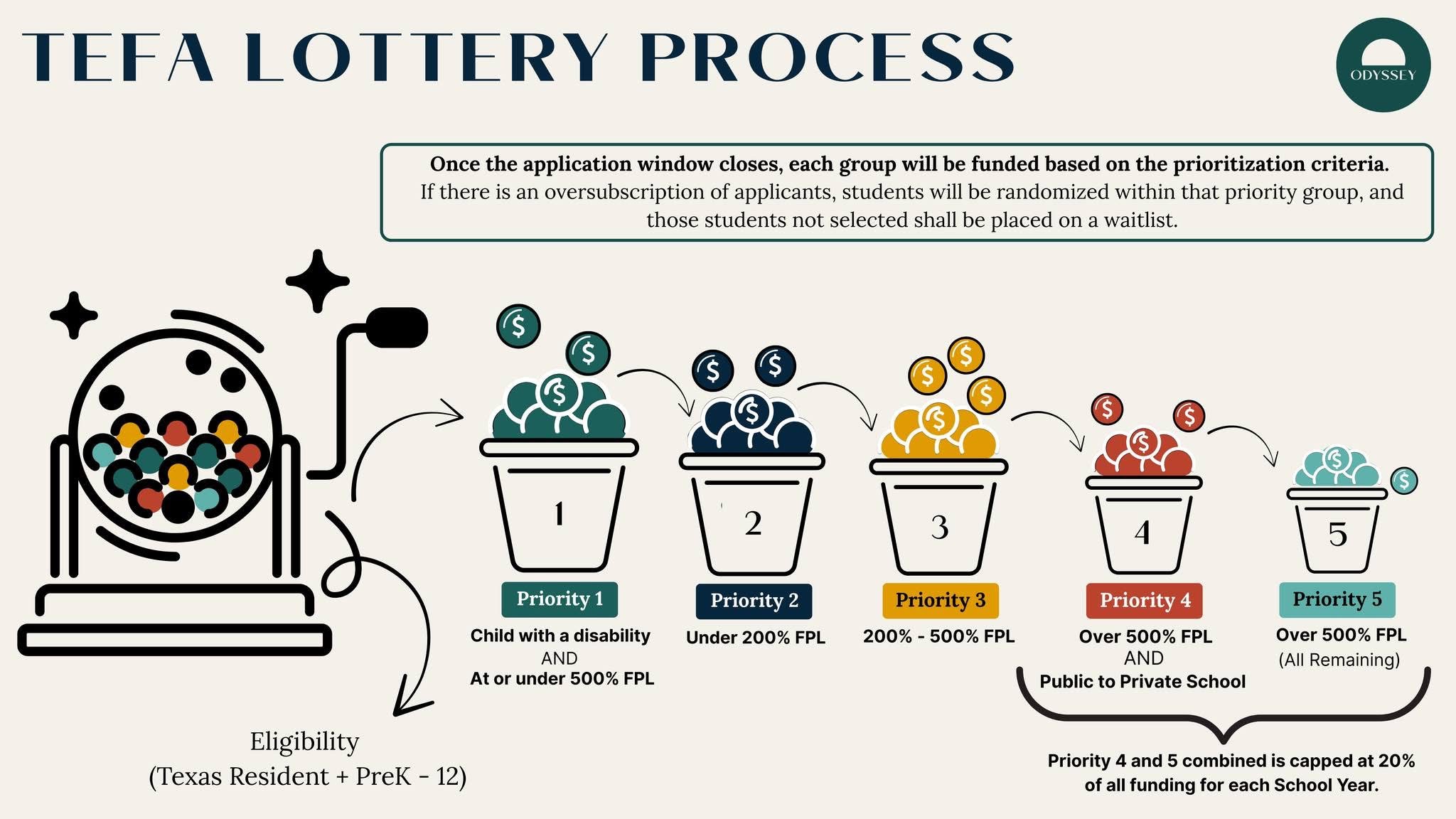
Not necessarily. If applications exceed available funding, a lottery will decide placement. State law sets this priority order:
- Year 1 – For the 2026-27 school year, applicants will be prioritized as follows:
- Children with a disability who are members of a household whose total annual income is at or below 500% of the Federal Poverty Level.*
- Children who are members of a household whose total annual income is at or below 200% of the Federal Poverty Level.
- Children who are members of a household whose total annual income is between 200% and 500% of the Federal Poverty Level.
- Children who are members of a household whose total annual income is at or above 500% of the Federal Poverty Level. Children who were enrolled in a Texas public school or charter
school for at least 90% of the prior school year will be prioritized within this group. Funds for children in this category may not exceed 20 percent of the amount of money appropriated from the program fund for that school year.
- *For purposes of prioritization, the term “children with a disability” includes both children with an IEP on file with the Texas Education Agency at the time the application process closes and children who have submitted a program-approved proof-of-disability form with their application. However, only those children with an IEP on file who are accepted into the program are eligible for the increased funding amount available to children with a disability.
Note: Federal Poverty Level guidelines are set annually by the U.S. Department of Health and Human Services. - Year 2 – After year 1, applicants will first be prioritized in the following order, and then will be prioritized within each group in the order stated in the year 1 prioritization:
- Siblings of participating children.
- New eligible program applicants.
- Prior program participants who ceased program participation due to enrollment in a public or charter school.
- If a child is accepted for participation during an application period, any eligible sibling of that child who applies during the same application period is also accepted for participation during that application period.
Who is eligible to submit an application on behalf of a child?
The parent of the child can submit an application. Parent means a resident of this state who is a natural or adoptive parent, managing or possessory conservator, legal guardian, custodian, or other person with legal authority to act on behalf of a child.
Do families need to reapply every year?
No. Participants in good standing stay in the program automatically. Families only need to confirm they want to continue.
Can funds be used for online or out-of-state programs?
Yes, if the provider applies for approval and is accepted into the program.
How will the program be monitored?
The Comptroller is required to contract with a private entity to audit accounts and program eligibility at least annually to ensure compliance with applicable law. The State Auditor will also perform periodic audits to verify compliance with eligibility requirements and that funds are used for approved expenses.
When can families apply?
The initial application period is expected to open on February 4, 2026. Families may sign up for updates from the Comptroller’s office.